Sudoku variant · rules and tips
Miracle Sudoku
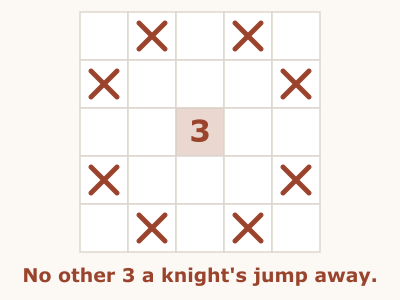
Three rules at once, and every one is about pairs of cells. Two of the same digit may never sit a knight's move apart: two squares one way and one square the other, the way a chess knight jumps.
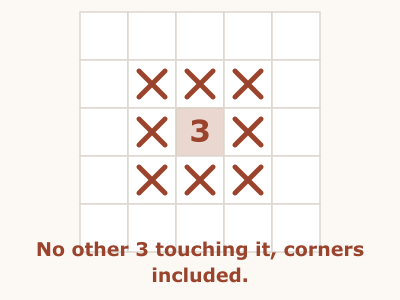
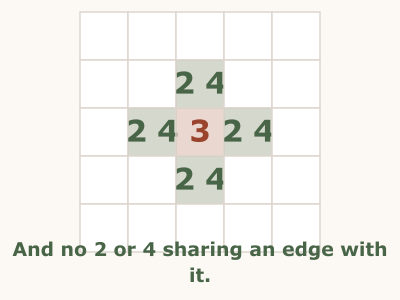
Two of the same digit may never touch at all, not even corner to corner. And two cells that share an edge, directly above, below, left or right, may never hold consecutive digits, so no 4 beside a 5. It sounds impossible. That is rather the point of the name.
Get it onGoogle PlayPlay Miracle Sudoku on the web
The Professor's tips
How do you solve Miracle Sudoku?
01 / Warm up
Start on a 4 by 4 grid
- These constraints are extraordinarily tight, and remarkably few arrangements survive them.
- The consecutive rule reaches further than you expect. Place a 2 and none of the four cells sharing an edge with it may hold 1 or 3.
- Think of each cell as carrying an enormous exclusion zone: its row, its column, its box, the eight cells touching it, as many as eight knight cells, and the four cells sharing an edge, which are barred from the digits either side of it.
02 / Level up
Then try a 6 by 6 grid
- The consecutive rule strikes two digits off each of the four cells sharing an edge with this one. Add the touching and knight rules and most cells are left with very few candidates.
- Place the extremes first. The digits at either end of the range forbid only one consecutive neighbour apiece, which makes them marginally freer than the rest.
- The knight chains are what carry you through. Place a 3 and every cell a knight's jump away is barred from 3, while the four cells sharing an edge with it are barred from 2 and 4.
- A Miracle puzzle often needs only one or two givens to have a single solution. The constraints do very nearly all of the work. You are merely the witness.
03 / Full size
Move on to a 9 by 9 grid
- The consecutive rule strikes two digits off each of the four cells sharing an edge with this one. Add the touching and knight rules and most cells are left with very few candidates.
- The knight chains are what carry you through. Place a 3 and every cell a knight's jump away is barred from 3, while the four cells sharing an edge with it are barred from 2 and 4.
- On a 9x9 grid the three rules together force a rigid pattern: the digits march diagonally in steps of 3. Find the rhythm once and the grid unrolls itself.
- A Miracle puzzle often needs only one or two givens to have a single solution. The constraints do very nearly all of the work. You are merely the witness.
- Think of each cell as carrying an enormous exclusion zone: its row, its column, its box, the eight cells touching it, as many as eight knight cells, and the four cells sharing an edge, which are barred from the digits either side of it.
The rule, drawn
What does Miracle Sudoku look like?
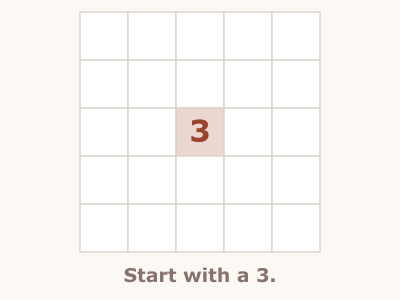
Start with a single square
Where can you play Miracle Sudoku?
Miracle Sudoku is one of the 17 variants in Cryptic, each with a lesson and unlimited puzzles.
Get it onGoogle PlayPlay on the web