Sudoku variant · rules and tips
Knight's Move Sudoku
No two identical digits may sit a chess knight's move apart. The knight moves in an L: two squares one way, then one square at a right angle. It is the most eccentric piece on the board, and it has brought its eccentricity with it.
Get it onGoogle PlayPlay Knight's Move Sudoku on the web
The Professor's tips
How do you solve Knight's Move Sudoku?
01 / Warm up
Start on a 4 by 4 grid
- On a 4 by 4 grid a knight in the corner reaches only one square. Trace the L shapes out from your cell before placing anything.
- Nothing on the grid marks this rule. You must carry it in your head, which is exactly where the best rules live. Notes will help.
- Think of it as one more region belonging to each cell: its row, its column, its box, and every square a knight could land on.
02 / Level up
Then try a 6 by 6 grid
- A knight at the centre of a 6 by 6 grid reaches as many as eight cells. That is a good deal more restrictive than most students expect.
- Edges and corners have fewer knight connections, so begin in the centre, where the rule bites hardest.
- Once a digit is placed, trace every L leading away from it. Not one of those landing squares may hold the same digit.
- The rule chains. If a 3 sits at R2C3 and a knight can reach R4C4, then R4C4 is not 3, which may in turn force the 3 elsewhere in that row. One jump, several consequences.
The rule, drawn
What does Knight's Move Sudoku look like?
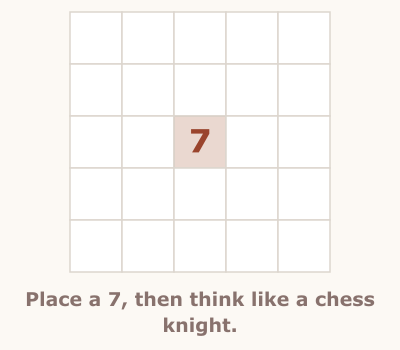
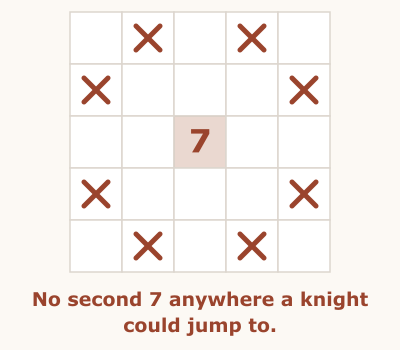
Start with a single square
Where can you play Knight's Move Sudoku?
Knight's Move Sudoku is one of the 17 variants in Cryptic, each with a lesson and unlimited puzzles.
Get it onGoogle PlayPlay on the web