Sudoku variant · rules and tips
Diagonal Sudoku
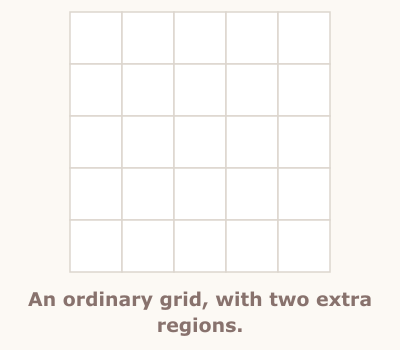
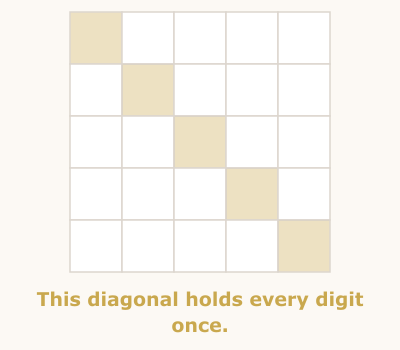
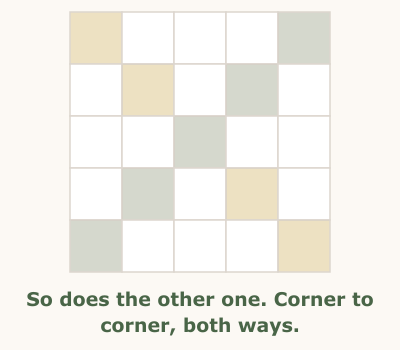
Both main diagonals, corner to corner, must also hold each digit exactly once, just as a row or a column does. Two extra regions, drawn at an angle, for the student who found rows too orthogonal.
Get it onGoogle PlayPlay Diagonal Sudoku on the web
The Professor's tips
How do you solve Diagonal Sudoku?
01 / Warm up
Start on a 4 by 4 grid
- Each diagonal holds four cells. With the ordinary rules and the diagonal rule together, the middle of the grid becomes very crowded indeed.
- A cell on a diagonal belongs to four regions at once: its row, its column, its box and the diagonal. Those are the most constrained cells on the board, so solve them first.
- A digit already on a diagonal cannot appear on it again. Obvious, yes. It is also the rule most often forgotten halfway through.
02 / Level up
Then try a 6 by 6 grid
- The two diagonals cross at the centre. On a 6 by 6 grid the central cells, R3C3, R3C4, R4C3 and R4C4, sit on or beside both of them.
- A diagonal cell that also lies in a central box is the most constrained cell you will find. Give it your attention early.
- Only certain cells are affected: those where the row equals the column, which is the main diagonal, and those where row plus column equals the size minus one, which is the anti-diagonal. If your cell lies on neither, this rule has nothing to say to it.
- When scanning for a digit, treat each diagonal as one more region to eliminate from. It will catch placements you would otherwise walk straight past.
The rule, drawn
What does Diagonal Sudoku look like?
Start with a single square
Where can you play Diagonal Sudoku?
Diagonal Sudoku is one of the 17 variants in Cryptic, each with a lesson and unlimited puzzles.
Get it onGoogle PlayPlay on the web