Sudoku variant · rules and tips
Arrow Sudoku
Every arrow has a circle and a path. The digit in the circle must equal the sum of the digits along the path. The circle is the total; the path is the working.
Get it onGoogle PlayPlay Arrow Sudoku on the web
The Professor's tips
How do you solve Arrow Sudoku?
01 / Warm up
Start on a 4 by 4 grid
- Take a circle with a two-cell path. It must equal the sum of two digits from 1 to 4, and since the circle itself cannot exceed 4, the options are few.
- A circle of 3 with a two-cell path leaves the path only 1 and 2. On a small grid the arithmetic is almost instant.
- The circle cannot be 1 when its path is longer than one cell, because the smallest sum available is 1 plus 2, which is 3.
02 / Level up
Then try a 6 by 6 grid
- A three-cell path drawn from 1 to 6 sums to somewhere between 6 and 15, yet the circle can be at most 6. So the sum is exactly 6 and the path must be 1, 2 and 3. Arithmetic, cornered, has no choice.
- Longer arrows constrain more, not less. The more cells in the path, the tighter the sum pins the circle, and the circle in turn pins the path.
- The path still obeys the ordinary rules, so its digits may not repeat within a row, a column or a box. Combine the sums with your usual elimination.
- If you already know the circle, work backwards. Ask which combinations of the right length add up to it, and cross out the rest.
The rule, drawn
What does Arrow Sudoku look like?
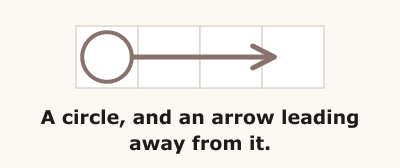
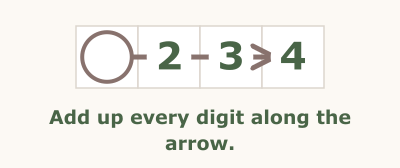
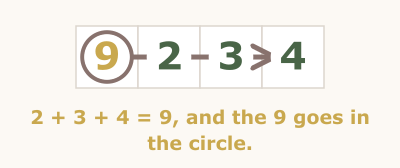
Start with a single square
Where can you play Arrow Sudoku?
Arrow Sudoku is one of the 17 variants in Cryptic, each with a lesson and unlimited puzzles.
Get it onGoogle PlayPlay on the web